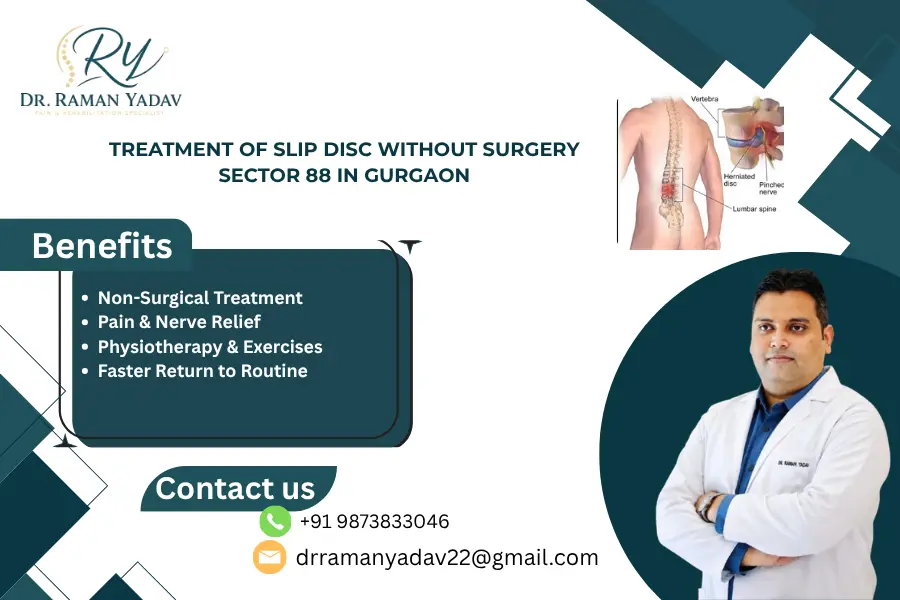
A slip disc can cause persistent back pain, neck discomfort, tingling, numbness, and pain that travels down the arms or legs. These symptoms may interfere with everyday activities such as walking, sitting, bending, working, and sleeping. However, a slip disc does not always require surgery. Many patients improve with appropriate non-surgical treatment, guided exercises, activity modification, and pain management.
Treatment of Slip Disc Without Surgery Sector 88 in Gurgaon focuses on identifying the cause of spinal discomfort and selecting a treatment plan suited to the patient’s symptoms and medical condition. Non-surgical approaches may help reduce pain, improve mobility, and support recovery when clinically appropriate.
Dr. Raman Yadav, Pain Specialist, provides care for conditions including back pain, neck pain, sciatica, and other musculoskeletal pain problems. Patients experiencing persistent spinal discomfort can seek an assessment to understand the possible causes of their symptoms and the treatment options available.
If you are looking for slip disc treatment in Gurgaon, an early clinical evaluation can help determine whether conservative treatment is suitable and whether further investigations are needed.
Understanding Slip Disc: Symptoms, Causes and Diagnosis
What Is a Slip Disc?
A slip disc, medically known as a herniated or prolapsed intervertebral disc, occurs when the soft inner material of a spinal disc pushes through a weakened or damaged outer layer. Spinal discs act as cushions between the vertebrae, helping the spine absorb pressure and move comfortably.
A herniated disc may irritate or compress nearby nerves, causing pain and other neurological symptoms. It can occur in the cervical spine (neck), thoracic spine (upper and middle back), or lumbar spine (lower back). Lumbar disc herniation is a common cause of lower back pain and sciatica.
The severity of symptoms depends on the location of the disc problem, the degree of nerve involvement, and the patient’s overall spinal health. Some people have disc changes visible on an MRI without experiencing significant symptoms.
Common Symptoms of a Slip Disc
Symptoms can vary depending on which part of the spine is affected.
- Lower back pain: Persistent or recurring pain in the lower back.
- Radiating leg pain: Pain travelling from the lower back into the buttock, thigh, calf, or foot.
- Neck pain: Discomfort or stiffness associated with a cervical disc problem.
- Tingling and numbness: Unusual sensations in the arms, hands, legs, or feet.
- Muscle weakness: Reduced strength in an affected limb in cases involving nerve compression.
- Pain during movement: Discomfort that worsens with certain bending, lifting, coughing, or sitting positions.
- Restricted mobility: Difficulty performing routine tasks because of pain or stiffness.
Symptoms do not always indicate a slip disc, as similar problems can occur with muscle strain, spinal stenosis, joint disorders, and other conditions. A proper clinical assessment is therefore important.
Seek emergency medical attention if you develop new difficulty passing urine, loss of bladder or bowel control, numbness around the groin or saddle region, or rapidly progressing leg weakness. These may indicate serious nerve compression requiring urgent assessment.
What Causes a Slip Disc?
Several factors can contribute to disc herniation:
- Age-related disc changes: Spinal discs gradually lose water content and flexibility with age.
- Improper lifting: Repeated heavy lifting or lifting with poor technique can increase stress on the spine.
- Prolonged sitting: Long periods in one position may aggravate back discomfort, particularly when combined with limited physical activity.
- Sudden strain or injury: An awkward movement, fall, or lifting incident may trigger symptoms.
- Repetitive physical stress: Jobs involving repeated bending, twisting, or heavy manual work may increase spinal strain.
- Excess body weight: Additional mechanical stress can contribute to back discomfort.
- Weak supporting muscles: Reduced strength and conditioning may make everyday physical activities more difficult.
Not every person with these risk factors develops a slip disc. In many cases, disc changes develop gradually rather than after a single identifiable injury.
How Is a Slip Disc Diagnosed?
Diagnosis generally begins with a medical history and physical examination. A specialist may ask when the pain started, whether it radiates into an arm or leg, and whether symptoms include numbness, tingling, or weakness.
The assessment may include:
- Evaluating spinal movement and areas of tenderness.
- Checking muscle strength, sensation, and reflexes.
- Assessing walking, balance, and nerve-related symptoms.
- Reviewing previous injuries, treatment, and medical conditions.
An MRI may be recommended when symptoms suggest significant nerve compression, when symptoms persist despite appropriate treatment, or when the findings could change the treatment plan. Imaging may be needed urgently if serious neurological symptoms are present. X-rays can help evaluate certain bone-related problems but do not directly show a herniated disc.
A diagnosis should be based on the patient’s symptoms and examination, supported by imaging when necessary, rather than on an MRI finding alone.
Treatment of Slip Disc Without Surgery Sector 88 in Gurgaon: Available Options
What Is Non-Surgical Slip Disc Treatment?
Non-surgical slip disc treatment aims to reduce pain, improve function, and help patients return to normal activities without an operation. The treatment plan depends on the location of the disc problem, the severity and duration of symptoms, nerve involvement, and the patient’s general health.
Treatment of Slip Disc Without Surgery Sector 88 in Gurgaon may involve a combination of conservative care, physiotherapy, medication when appropriate, and selected pain-management procedures.
Most patients without serious neurological complications can initially be assessed for non-surgical management. However, persistent or progressive nerve symptoms may require specialist review and, in some cases, surgical consultation.
Non-Surgical Treatment Options
1. Medication for Pain Relief
A clinician may recommend appropriate pain-relieving or anti-inflammatory medication after considering the patient’s medical history, existing medicines, and potential side effects.
Medication may help control symptoms sufficiently for the patient to move comfortably and participate in rehabilitation. It does not directly repair a herniated disc, and certain medicines may be unsuitable for people with kidney disease, stomach ulcers, cardiovascular conditions, or other health concerns.
Patients should avoid prolonged self-medication and should not start prescription medicines without professional advice.
2. Physiotherapy and Therapeutic Exercises
Physiotherapy can help improve spinal mobility, strengthen supporting muscles, and develop safer movement patterns. Depending on the assessment, a physiotherapist may recommend:
- Gentle mobility exercises.
- Progressive core-strengthening exercises.
- Exercises targeting hip and back flexibility.
- Nerve-mobility exercises when indicated.
- Posture and lifting education.
- A gradual return to daily activities.
Exercises should be tailored to the individual’s condition. Movements that substantially increase radiating pain, numbness, or weakness should be stopped and reviewed with the treating professional.
3. Activity Modification
Complete bed rest is generally not recommended for uncomplicated back pain. Gentle movement and short walks, as tolerated, can help maintain function.
Patients may be advised to temporarily reduce heavy lifting, repeated twisting, or activities that consistently worsen symptoms. Changing positions regularly and gradually increasing activity can be more helpful than remaining inactive for long periods.
4. Interventional Pain Management
For selected patients whose pain remains significant despite initial treatment, a specialist may consider an image-guided injection, such as an epidural steroid injection, depending on the diagnosis.
These procedures may reduce inflammation around an irritated nerve and provide temporary symptom relief. They do not remove the herniated disc, and their benefits vary between patients.
The decision to use an injection should consider the source of pain, examination findings, potential risks, and expected benefits. Not every patient requires an interventional procedure.
How Dr. Raman Yadav May Help
Dr. Raman Yadav is associated with pain management and the evaluation of conditions such as back pain, neck pain, sciatica, and frozen shoulder.
For patients seeking Treatment of Slip Disc Without Surgery Sector 88 in Gurgaon, consultation can help clarify whether the symptoms are consistent with a disc problem and which management options may be appropriate.
The assessment may guide decisions about conservative care, physiotherapy, medication, or further investigation. Any intervention should be recommended only when supported by the patient’s clinical findings.
Benefits of Non-Surgical Treatment
When appropriate for the patient’s condition, non-surgical management may offer several benefits:
- Avoiding surgery: Many patients improve without an operation.
- Pain management: Treatment may reduce discomfort and help restore everyday function.
- Improved mobility: Tailored exercises and activity progression can support movement.
- Individualised care: Treatment can be adapted according to symptoms, examination findings, and response.
- Gradual return to activities: Patients can work towards resuming normal routines as their symptoms improve.
- Lower procedural burden: Conservative care avoids the immediate risks and recovery demands associated with spinal surgery.
These benefits are not guaranteed. The outcome depends on the underlying problem, the degree of nerve involvement, the patient’s general health, and adherence to an appropriate treatment plan.
Recovery, Treatment Comparison and Cost Factors
How Long Does Recovery Take?
Recovery from a slip disc varies considerably. Some patients experience improvement within a few weeks, while others require several months of treatment and rehabilitation. The timeline depends on the location and severity of the disc herniation, nerve involvement, and individual healing.
A typical recovery plan may include the following stages:
Initial phase: The focus is on controlling pain, identifying warning signs, and maintaining gentle movement as tolerated.
Rehabilitation phase: As symptoms improve, progressive exercises may help restore strength, flexibility, and confidence with movement.
Return-to-activity phase: Patients gradually resume work, walking, household activities, and exercise according to their symptoms and professional advice.
Long-term management: Maintaining physical activity, using safe lifting techniques, and following an appropriate exercise routine may help reduce future episodes of back pain.
Recovery is not always linear. If pain worsens significantly, new weakness develops, or symptoms spread, the treatment plan should be reassessed.
Non-Surgical Treatment vs Surgery
The choice between conservative treatment and surgery depends on the diagnosis, symptom severity, and neurological findings.
| Factor | Non-surgical treatment | Surgery |
| Main approach | Medication, rehabilitation, activity modification, and selected injections | Surgical decompression or another procedure when indicated |
| Typical role | Initial management for many patients without serious neurological complications | Selected cases with severe or persistent symptoms or significant nerve compression |
| Recovery | Usually gradual, with progress depending on symptoms and treatment | Depends on the procedure, individual health, and rehabilitation |
| Potential benefits | Avoids surgical risks and may improve pain and function | May relieve pressure on a nerve and improve selected symptoms |
| Limitations | May not provide sufficient relief in every case | Carries surgical risks and may not resolve every symptom |
Surgery is not automatically necessary because an MRI shows a herniated disc. However, urgent surgical assessment may be required for serious neurological symptoms, and elective surgery may be considered when appropriate non-surgical care fails to provide adequate relief.
The decision should be made after discussing the expected benefits, risks, alternatives, and the patient’s preferences with the relevant specialists.
What Determines the Cost of Slip Disc Treatment in Gurgaon?
There is no single price for slip disc treatment because the required care varies from patient to patient. A personalised estimate should be obtained after clinical evaluation.
Factors that may influence the overall cost include:
- The initial consultation and clinical examination.
- Whether an MRI or other diagnostic investigation is needed.
- The number and type of physiotherapy sessions.
- Prescribed medication and follow-up visits.
- Whether an image-guided pain-management procedure is recommended.
- The complexity of the condition and duration of treatment.
- Whether specialist referrals or additional investigations are necessary.
Patients should ask for a clear explanation of recommended services and their charges before proceeding. An expensive treatment or procedure is not automatically more effective, and not every patient needs injections or surgery.
Finding Slip DiscTreatment Near Sector 88, Gurgaon
Patients searching for slip disc treatment or back pain treatment near me should look for a clinician who assesses the underlying cause of pain, explains available options, and provides appropriate follow-up.
Dr. Raman Yadav’s listed clinic address is:
Rail Vihar, Plot No. 1287N, Block H, Sector 57, Gurugram, Haryana – 122011.
This address is in Sector 57, not Sector 88. Patients living in Sector 88 should confirm the clinic location, appointment availability, and travel arrangements before visiting.
Frequently Asked Questions About Slip Disc Treatment
1. Can a slip disc be treated without surgery?
Yes. Many patients improve with non-surgical treatment, including activity modification, physiotherapy, and appropriate medication. Selected patients may benefit from pain-management procedures. The right approach depends on the diagnosis and severity of symptoms.
2. How long does a slip disc take to heal without surgery?
Many patients experience improvement over several weeks, although recovery may take longer when symptoms are severe or nerve irritation persists. A clinician can provide more individualised guidance after an assessment.
3. Is physiotherapy effective for slip disc treatment?
Physiotherapy can help improve mobility, strengthen supporting muscles, and restore function. The exercise programme should be tailored to the patient’s symptoms and examination findings.
4. Can a slip disc cause sciatica?
Yes. A herniated disc in the lower back can irritate or compress a nerve root, causing pain that travels through the buttock and down the leg. This pattern is commonly known as sciatica, although other conditions can also cause similar symptoms.
5. Is an MRI necessary before starting treatment?
Not always. Many uncomplicated cases of back pain can initially be assessed clinically. An MRI may be appropriate when symptoms persist, serious nerve compression is suspected, or imaging is likely to change management.
6. When is surgery necessary for a slip disc?
Surgery may be considered when significant symptoms persist despite appropriate non-surgical care or when there is substantial nerve compression. New bladder or bowel dysfunction, saddle numbness, or rapidly progressive weakness requires emergency assessment.
7. Can I walk with a slip disc?
Gentle walking is often encouraged when tolerated, as prolonged bed rest can contribute to stiffness and reduced fitness. However, activity should be adjusted if it significantly worsens symptoms, and new weakness or severe radiating pain should be assessed.
8. What is the cost of non-surgical slip disc treatment in Gurgaon?
The cost depends on consultation fees, investigations, rehabilitation requirements, medication, follow-up, and whether a pain-management procedure is needed. An individual estimate is best obtained after assessment.
9. Where can I consult Dr. Raman Yadav for back pain?
The listed address is Rail Vihar, Plot No. 1287N, Block H, Sector 57, Gurugram, Haryana – 122011. Contact the clinic to confirm the appointment, available services, and whether the consultation is appropriate for your symptoms.
Conclusion: Choose an Individualised Approach to Slip Disc Treatment
A slip disc can affect mobility, sleep, work, and quality of life, but surgery is not the only treatment option. Many patients can improve with an appropriate combination of conservative management, guided exercises, activity modification, and pain relief.
Treatment of Slip Disc Without Surgery in Sector 88, Gurgaon, should begin with an accurate assessment of symptoms and the underlying cause. Similarly, patients experiencing persistent joint discomfort may benefit from Chronic Joint Pain Treatment in Gurgaon and Non-Surgical Joint Pain Treatment in Gurgaon, depending on their condition and medical evaluation.
Dr. Raman Yadav provides pain-management care for conditions including back pain, neck pain, sciatica, and joint pain. A consultation can help patients understand the available treatment options and determine whether non-surgical management is appropriate.
Book an Appointment for Slip Disc and Back Pain Treatment
Do not ignore persistent back pain, radiating leg pain, tingling, or numbness. An appropriate assessment can help identify the cause and establish a treatment plan suited to your needs.
Consultation details
- Doctor: Dr. Raman Yadav – Pain Specialist
- Location: Rail Vihar, Plot No. 1287N, Block H, Sector 57, Gurugram, Haryana – 122011
- Contact number: 098738 33046
Book an appointment to discuss your symptoms, understand your treatment options, and plan the next steps towards improved mobility and pain management.