
Pain Physician in Gurgaon – Dr. Raman Yadav
Back, neck, joint or nerve pain that will not settle needs a clear diagnosis, not just another round of painkillers. Dr. Raman Yadav is a pain physician in Gurgaon (Sector 88) who works out where your pain is coming from and builds a non-surgical plan around it, using medicines, rehabilitation and, where they suit you, image-guided procedures.
- MBBS
- MD, Physical Medicine & Rehabilitation
- Fellowship in Pain Medicine (FIPM)
- Non-surgical, image-guided care
Dr. Raman Yadav holds an MBBS, an MD in Physical Medicine & Rehabilitation and a Fellowship in Pain Medicine (FIPM). Learn more about Dr. Raman Yadav.
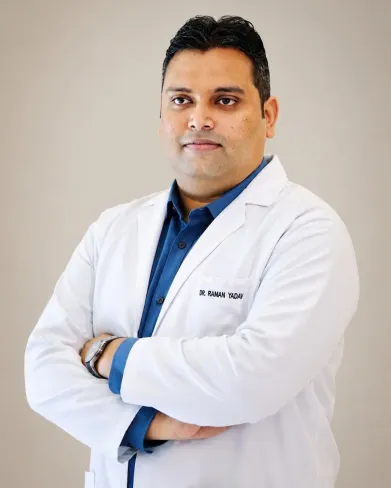
Pain Management Specialist in Gurgaon: What a Pain Physician Does
A pain physician is a doctor trained to find out why pain is happening and which treatments are most likely to help. Training routes differ. In India many pain physicians come from anaesthesiology, while Dr. Raman Yadav trained in physical medicine and rehabilitation before his pain medicine fellowship. At a visit, a pain physician usually:
- takes a detailed history and examines you
- reads your scans and reports alongside your symptoms
- separates pain from nerves, joints, muscles, tendons or the spine
- prescribes medicines with attention to side effects and interactions
- performs targeted procedures such as nerve blocks when they suit the diagnosis
- works with physiotherapy so that relief turns into better movement
Good pain care is not only about procedures. NICE guidance on chronic pain stresses exercise, psychological support and self-management, and advises against starting medicines such as opioids and gabapentinoids for chronic primary pain, meaning long-term pain without a clear underlying cause.
Who Needs a Pain Treatment Doctor in Gurgaon?
Consider seeing a pain physician if:
- pain has lasted more than a few weeks or keeps returning
- pain spreads into an arm or leg, or comes with tingling, numbness or weakness
- pain disturbs sleep, work or exercise
- you depend on painkillers or have side effects from them
- earlier treatment has not given enough relief
- pain follows surgery, shingles, chemotherapy or cancer treatment
Pain lasting longer than three months is generally called chronic pain.
Get urgent medical care instead if back or neck pain comes with new weakness in a limb, loss of bladder or bowel control, numbness between the legs, fever, unexplained weight loss, or follows a serious injury.
Conditions Dr. Raman Yadav Treats
| Area | Examples | Learn more |
|---|---|---|
| Spine pain | Back pain, neck pain, sciatica, slipped disc | Spine pain treatment |
| Joint pain | Knee, shoulder, hip, ankle, elbow | Joint pain treatment |
| Nerve pain | Diabetic neuropathy, post-shingles pain, trigeminal neuralgia | Neuropathic pain treatment |
| Sports injuries | Tendon, ligament and muscle injuries | Sports injuries treatment |
| Heel and elbow pain | Plantar fasciitis, tennis elbow, golfer's elbow | Heel and elbow pain treatment |
| Cancer pain | Pain from a tumour or its treatment | Cancer pain treatment |
| Long-term pain | Persistent pain from mixed causes | Chronic pain treatment |
Related reading: neck pain treatment in Sector 88, choosing a doctor for sciatica, non-surgical knee pain treatment and rotator cuff injury treatment.
How a Pain Consultation Works, Step by Step
- History. Where the pain is, when it started, what makes it better or worse, your medicines and health conditions.
- Examination. Movement, strength, reflexes and sensation help pinpoint the source.
- Reports. Bring scans and tests. Findings are matched with your symptoms because a scan alone does not always explain pain.
- Diagnosis and plan. You hear the likely cause, your options, the risks and what is not worth trying.
- Treatment. This may be medicines and rehabilitation, with an ultrasound- or fluoroscopy-guided procedure for selected patients. Sometimes a diagnostic block comes first to confirm the pain source.
- Follow-up. Your response is reviewed and the plan adjusted.
Treatment Options and What the Evidence Says
Not every treatment suits every pain, and the evidence differs by condition.
- Rehabilitation and exercise: the foundation of most plans.
- Medicines: chosen for the type of pain and your health. Nerve pain responds to different drugs than muscle pain.
- Epidural and nerve root injections: used for sciatica from an irritated nerve. NICE suggests considering them for acute, severe sciatica and advises against spinal injections for low back pain without sciatica.
- Radiofrequency treatment: NICE supports it for chronic low back pain only after a positive diagnostic block. For knee arthritis, reviews disagree. A 2025 meta-analysis of 25 trials found low-certainty evidence and modest, short-lived benefit, while a 2026 meta-analysis of sham-controlled trials reported meaningful improvement, mainly with conventional monopolar radiofrequency. It suits selected patients, not everyone.
- PRP therapy: used for selected tendon problems such as tennis elbow. Results vary by condition and person.
- Spinal cord stimulation and pain pumps: reserved for severe pain that has not responded to standard treatment.
A good pain physician also tells you when an injection is unlikely to help and when a surgeon is the better next step.
Benefits of Seeing a Pain Physician
- One plan that combines medicines, exercise and procedures
- Targeted options when tablets and physiotherapy are not enough
- A review of medicines to cut down unnecessary or risky combinations
- Honest advice on when surgery or another specialist is the better route
Results vary, and no treatment can guarantee relief.
Pain Physician vs Other Options
| Option | Role | Best suited to | Limits |
|---|---|---|---|
| Self-care and activity changes | First step | Mild, recent pain | May not be enough for nerve or persistent pain |
| Physiotherapy | Builds strength, movement and posture | Most muscle and joint pain | Needs time and regular effort |
| Medicines from a general doctor | Short-term relief | Recent pain | Long-term use alone has limits and side effects |
| Pain physician | Diagnosis, medicines, procedures, rehabilitation planning | Pain that persists despite basic care, nerve pain, mixed causes | Procedures help selected patients, not all |
| Orthopaedic or spine surgeon | Operates on structural problems | Progressive weakness, severe nerve compression, advanced joint damage | Surgery has its own risks and recovery |
Who Is a Good Candidate?
You may be suitable if pain persists despite basic care, a likely source can be identified, you wish to avoid or delay surgery, and you can take part in rehabilitation.
Another route may come first if you have the warning signs listed above, progressive weakness, a suspected infection or tumour not yet assessed, blood-thinner use that cannot be paused safely, an infection near the injection site, poorly controlled diabetes, pregnancy (for X-ray-guided procedures), or allergy to contrast dye or local anaesthetic. The doctor decides after assessment.
Risks and Safety
Every procedure carries risks, which should be explained before you agree.
- Common and usually short-lived: soreness at the needle site, a temporary pain flare, bruising, and a temporary rise in blood sugar after steroids in people with diabetes.
- Rare but serious: infection, bleeding and nerve injury. In 2014 the US FDA warned that epidural corticosteroid injections can rarely cause serious neurological problems, including loss of vision, stroke, paralysis and death, and noted that these drugs are not approved for epidural use. Careful technique and imaging aim to lower risk but cannot remove it.
- Blood thinners: tell your doctor about aspirin, clopidogrel, warfarin, newer anticoagulants, anti-inflammatory painkillers and supplements. Specialist guidance sets different hold times by procedure, and you should never stop a prescribed medicine without advice from the prescribing doctor.
After a procedure: seek emergency care for new weakness or numbness, severe headache, vision changes, fever, or spreading redness or swelling.
Recovery and Aftercare
Many injections and nerve blocks are day-care procedures, and your doctor will confirm what applies to you. Rest for the rest of the day, return to light activity as advised, and expect that relief can build gradually. Physiotherapy usually follows, and chronic conditions can need weeks to months of rehabilitation. If sedation is used, arrange a companion and avoid driving that day.
Pain Physician Consultation Fees in Gurgaon: What Affects the Cost
Consultation fees for a pain physician in Gurgaon are not fixed. They depend on the doctor, the setting and what the visit includes, and they are separate from the cost of tests or procedures. The total is shaped by:
- Consultation: first visit or follow-up, hospital or clinic setting
- Investigations: X-rays, MRI, nerve tests or blood tests if not already done
- Procedure type: injection, radiofrequency, PRP or an implanted device
- Facility costs: day-care bed, imaging guidance, sedation or anaesthesia
- Insurance: ask your insurer whether day-care procedures are covered
Ask the clinic for the current consultation fee on +91 9873833046 and request an itemised estimate before agreeing to any procedure.
How to Choose the Right Pain Physician in Gurgaon
If you are looking for the best pain physician in Gurgaon, "best" should mean the best fit for your problem, not the loudest advertising. Look for a doctor who:
- has verifiable credentials and medical council registration
- has training in pain medicine or a related specialty
- explains your diagnosis and all options, including non-surgical ones
- is honest about risks and limits, and promises no cure or guaranteed result
- uses image guidance for spinal and joint injections where appropriate
- combines procedures with rehabilitation and follow-up
- is open about fees and will refer you to a surgeon when needed
Be cautious of claims of "permanent" relief. Medical advertising rules in India restrict exaggerated claims.
Why Choose Dr. Raman Yadav as Your Pain Physician in Gurgaon
- Training: MBBS from Maharshi Dayanand University, Rohtak; MD in Physical Medicine & Rehabilitation from Guru Gobind Singh Indraprastha University, New Delhi; Fellowship in Pain Medicine at Sir Ganga Ram Hospital, New Delhi.
- Rehabilitation background: supports rebuilding movement and strength after pain is controlled.
- Approach: evidence-based, non-surgical, image-guided techniques for selected patients.
- Range: spine, joint, nerve, sports, cancer and long-term pain, each with its own treatment page.

FAQs
When should I see a pain physician in Gurgaon?
Consider a pain physician in Gurgaon if pain lasts more than a few weeks, keeps returning, spreads into an arm or leg, disturbs sleep, or has not improved with basic treatment. Sudden weakness, loss of bladder or bowel control, or pain after a major injury needs urgent care instead.
What is the difference between a pain physician and an orthopaedic surgeon?
A pain physician focuses on diagnosing pain and treating it with medicines, rehabilitation and targeted procedures. An orthopaedic or spine surgeon operates on structural problems. Many people see a pain physician first, and a good one refers you for a surgical opinion when needed.
How much is a pain physician consultation fee in Gurgaon?
The fee depends on the doctor, the setting and what the visit includes, and it is separate from the cost of any procedure or scans. Ask the clinic for the current fee when you book, and request an itemised estimate before agreeing to a procedure.
Are nerve blocks and epidural injections safe?
They are generally well tolerated when done for the right reason, but every procedure carries risks, including soreness, infection, bleeding and, rarely, nerve injury. Regulators have warned of rare serious neurological events after epidural steroid injections, so discuss benefits and risks first.
How long does pain relief from an injection or radiofrequency treatment last?
It varies widely between people and conditions. Some feel relief for weeks or months, while others gain little. Research on radiofrequency treatment for knee and back pain is mixed, so your doctor should explain realistic expectations before you decide.
Can chronic back pain be treated without surgery?
Often, yes. Many people improve with exercise-based rehabilitation, activity changes, suitable medicines and, for selected patients, image-guided procedures. Surgery is usually considered when there is progressive weakness, severe nerve compression, or when appropriate non-surgical care has not worked.
Do I need an MRI before seeing a pain physician?
Not always. Bring any scans or reports you already have, but the doctor decides after examining you whether imaging is needed. A scan finding alone does not always explain pain, so it is read together with your symptoms.
What should I bring to my first pain consultation?
Bring previous scans and reports, prescriptions or a list of medicines (especially blood thinners, aspirin and diabetes medicines), and notes on when the pain began and what worsens it. Tell the doctor about allergies, pregnancy and any earlier injections or surgery.
When should I go to the emergency room instead of booking a pain consultation?
Seek emergency care for new weakness in an arm or leg, loss of bladder or bowel control, numbness between the legs, fever with severe back pain, or pain after serious trauma. After an injection, new weakness, vision changes or a severe headache also need urgent attention.
Book a Consultation with a Pain Physician in Gurgaon
Ready to talk to a pain physician in Gurgaon? Call, message or book online.
Dr. Raman YadavOptimus Hospital, Main Pataudi Gurgaon Road, opposite JSS Honda showroom, Harsaru, Sector 88, Gurugram, Haryana 122505
Phone: +91 9873833046
Email: drramanyadav22@gmail.com
Prefer a call back? Send your details
Medical disclaimer: This page is for general information and does not replace medical advice, diagnosis or treatment. Results vary and no outcome is guaranteed. In an emergency, go to the nearest hospital.
References
| Source | What it supports on the page |
|---|---|
| NICE NG193: Chronic pain (primary and secondary) in over 16s, 2021 | Chronic pain means pain lasting more than 3 months. For chronic primary pain: exercise, psychological therapy, and advice not to start opioids, gabapentinoids, benzodiazepines or ketamine. |
| NICE NG59: Low back pain and sciatica in over 16s | No spinal injections for low back pain (1.3.1). Consider epidural local anaesthetic and steroid for acute, severe sciatica (1.3.5). Radiofrequency denervation only after a positive diagnostic medial branch block (1.3.3). No routine imaging in non-specialist settings (1.1.4). |
| US FDA Drug Safety Communication, 23 April 2014 | Rare but serious neurological events after epidural corticosteroid injections (vision loss, stroke, paralysis, death). Corticosteroids are not approved for epidural use. |
| Efficacy and safety of minimally invasive interventions targeting the genicular nerves for knee osteoarthritis: a meta-analysis. Osteoarthritis Cartilage, 2025 | 25 trials, low to very low certainty, modest short-term benefit not sustained. |
| Efficacy and safety of genicular nerve ablation techniques for knee osteoarthritis: systematic review and meta-analysis of sham-controlled trials. Pain Med, 2026 | Meaningful pain and function improvement with a favourable safety profile, especially conventional monopolar radiofrequency. |
| Narouze S, et al. Interventional spine and pain procedures in patients on antiplatelet and anticoagulant medications (second edition). Reg Anesth Pain Med 2018 | Hold times for blood thinners depend on procedure bleeding risk and the drug. |
| Faculty of Pain Medicine, Royal College of Anaesthetists: What is a Pain Medicine doctor? | Role of a pain medicine specialist: medicines, interventional techniques, multidisciplinary care. |
| Role of a pain physician in India. Indian J Anaesth (PMC7980244) | Anaesthesiologists commonly enter pain medicine in India; a pain physician assesses pain and is skilled in interventional procedures. |
| Dr. Raman Yadav's website, About and treatment pages | Credentials, institutions, procedures offered, image guidance, address and phone. |